
About the Rwenzori Mountains
The Rwenzori Mountains National Park rise through the clouds along the border of Uganda and the Democratic Republic of Congo like something from another world. Known for centuries as the legendary “Mountains of the Moon,” the Rwenzori range is one of Africa’s most dramatic and least explored natural wonders.
Unlike the volcanic peaks of Kilimanjaro and Mount Kenya, the uplifting of ancient rock deep within the East African Rift Valley millions of years ago formed the Rwenzori Mountains. Today, they remain the highest non-volcanic mountain range in Africa, crowned by Mount Stanley’s Margherita Peak at 5,109 meters, the third-highest point on the continent (Wikipedia).
What makes the Rwenzori truly extraordinary is the contrast. Within a single expedition, travelers move through dense tropical rainforest, bamboo forests, giant heather zones, afro-alpine bogs, glacier valleys, and snow-covered peaks near the equator. Few places on Earth compress so many ecosystems into one mountain range.
The mountains also serve as one of the most important water catchments in East Africa. Their rivers, wetlands, and glaciers feed communities across western Uganda and contribute to the upper Nile basin. UNESCO describes the Rwenzori as the highest and most permanent source of the Nile River system (UNESCO World Heritage Centre).
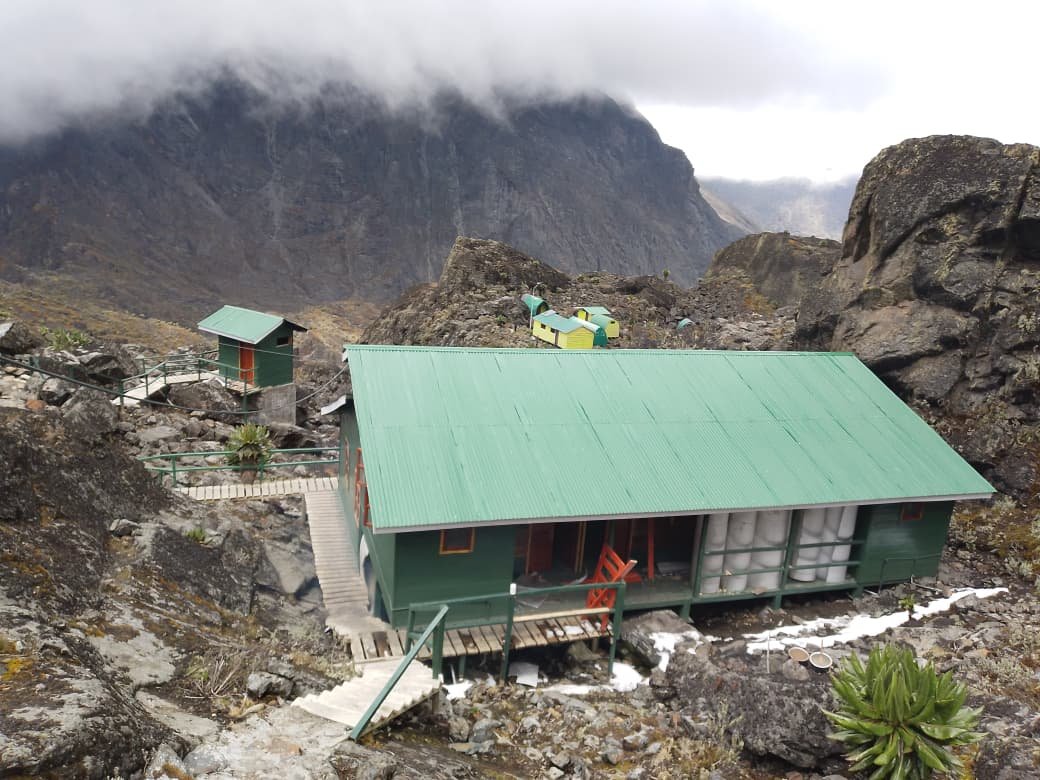
A Landscape Wrapped in Myth and History
For over two thousand years, stories of snow-capped mountains near the equator puzzled ancient geographers. Greek scholar Ptolemy referred to a mysterious range called the “Mountains of the Moon,” believed to be the source of the Nile. Many historians now associate that legend with the Rwenzori Mountains (NASA Science).
European explorers first documented the range in the late 19th century, but long before outsiders arrived, the mountains already deeply influenced the spiritual and cultural identity of the Bakonzo and Bamba peoples who live along their slopes.
Among the Bakonzo, the mountains are not simply geography. They are sacred. Traditional beliefs describe the peaks as the dwelling place of Kitasamba, a powerful spiritual figure connected to rain, fertility, and protection. Sacred forests, rivers, caves, and ridges across the mountain still hold cultural significance today (UNESCO World Heritage Centre).
The mountain itself has always shaped life in the Rwenzori foothills. Farming traditions, music, storytelling, architecture, herbal medicine, and seasonal rituals evolved around the rhythms of the highlands. Even today, many local guides carry generations of inherited mountain knowledge passed down through families.
Flora Found Nowhere Else on Earth
The Rwenzori Mountains contain some of the richest montane vegetation in Africa. Because of the altitude, humidity, and isolation of the range, many species found here exist nowhere else on Earth (UNESCO World Heritage Centre).
As trekkers climb higher, the landscape changes dramatically. The lower slopes feature tropical rainforests filled with giant ferns, mahogany trees, moss-covered vines, and dense bamboo forests alive with birds and primates.
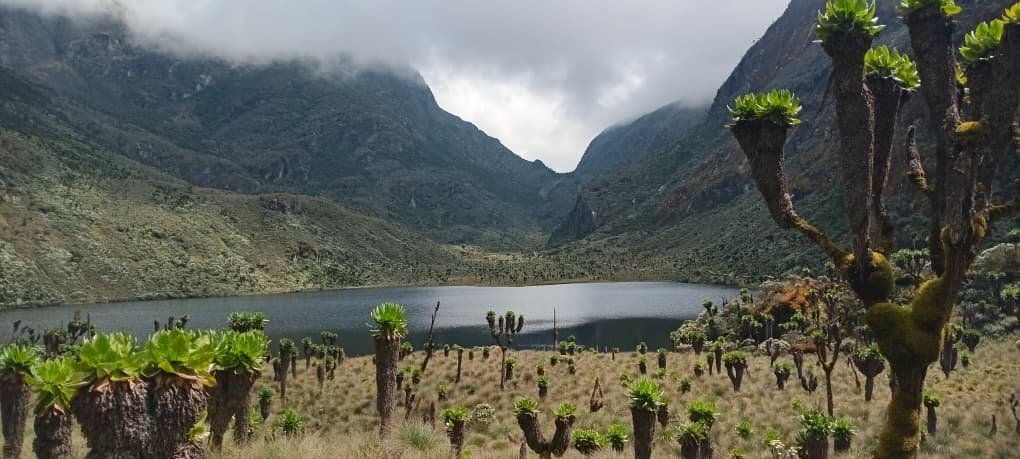
Above the forests lies the afro-alpine zone, the most iconic part of the Rwenzori ecosystem. Here, giant lobelias and towering groundsels grow through thick mist like plants from a prehistoric world. Massive heathers draped in old-man’s moss line the valleys, while bogs and glacial streams carve through the high-altitude terrain. Scientists often describe this region as one of Africa’s most unique botanical environments (UNESCO World Heritage Centre).
Altitude, rainfall, and temperature shape the five major ecological zones that divide the mountain vegetation. UNESCO designated the Rwenzori Mountains a World Heritage Site in 1994 largely because of this unique, layered ecosystem (UNESCO World Heritage Centre).
Wildlife of the Rwenzori Region
The Rwenzori ecosystem supports an impressive diversity of wildlife, especially within the Albertine Rift, one of Africa’s most important biodiversity hotspots. The forests are home to:
- Forest elephants
- Eastern chimpanzees
- L’Hoest’s monkeys
- Black-and-white colobus monkeys
- Three-horned chameleons
- Rwenzori duikers
- Bushbuck
- Giant forest hogs
Birdlife is particularly remarkable. Researchers have recorded more than 217 bird species in the park, including several Albertine Rift endemics such as the Rwenzori turaco, handsome francolin, and Archer’s robin-chat (UNESCO World Heritage Centre).
The surrounding region also connects travelers to nearby ecosystems like Queen Elizabeth National Park, Bwindi Impenetrable National Park, and Kibale National Park, creating one of the most biodiverse safari circuits in East Africa.
Climate Change and Environmental Threats
The Rwenzori Mountains are changing rapidly. In the early 1900s, the range contained more than 40 named glaciers covering roughly 7.5 square kilometers. Today, most of that ice has disappeared. Scientific surveys show that glaciers on Mount Baker and Mount Speke have already vanished, while the remaining ice on Mount Stanley continues to shrink at an alarming pace (Wikipedia).
UNESCO has warned that many tropical glaciers in Africa may disappear entirely within decades due to rising global temperatures. Some estimates suggest the Rwenzori glaciers have already lost over 80% of their ice coverage compared to the beginning of the 20th century (UNESCO).
The consequences reach far beyond the mountains themselves:
- Altered water systems
- Increased flooding and landslides
- Habitat loss for endemic species
- Pressure on farming communities
- Changing tourism patterns
- Loss of critical climate records preserved in glacial ice
Population pressure around the mountain slopes has also increased significantly over the past decades, creating challenges related to land use, firewood collection, agriculture, and conservation (UNESCO World Heritage Centre).
Despite these threats, conservation efforts led by local communities, researchers, the Uganda Wildlife Authority, and UNESCO continue to protect the fragile ecosystems of the Rwenzori.
The Spirit of the Mountains
The Rwenzori are not mountains people simply visit. They are mountains people feel.
There is a silence in the upper valleys that cannot be explained in photographs. Mist moves slowly through giant heather forests. Glacial rivers echo through the rocks. Villages disappear into the clouds by evening. Every trail carries stories older than modern maps.
For the Bakonzo people, the mountains are part of identity itself. For travelers, the Rwenzori remain one of the last truly wild expeditions in Africa.