
rwenzori hantravel safaris
GREAT LAKES BUSH VIPER
Discover the Great Lakes Bush Viper, a highly venomous and striking green predator native to the high-altitude forests of the Albertine Rift.
Hidden within the dense, misty undergrowth of the lower Rwenzori Mountains, the Great Lakes Bush Viper (Atheris nitschei) is a striking, bright green predator endemic to the Albertine Rift. This highly venomous, arboreal snake thrives perfectly camouflaged among the mountain’s thick elephant grass, papyrus swamps, and low-hanging montane forest vines. For wildlife photographers and trekkers exploring Uganda’s rich biodiversity, spotting this elusive ambush predator with its distinct triangular head and heavily keeled, bristly scales offers a thrilling and unforgettable glimpse into the untamed, lower-altitude ecosystems of the Mountains of the Moon.
Quick Facts
Scientific Name: Atheris nitschei
Average Length: 60 – 80 cm
Diet: Frogs & Lizards
Elevation: 1,600 – 2,800m
Mountain Habitat
Thriving in the high-altitude environments of Uganda. They live in mountain forests, elephant grass marshes, and wetland areas up to the bamboo zone. The constant moisture and dense foliage of the Albertine Rift provide the perfect cover for these ambush predators.
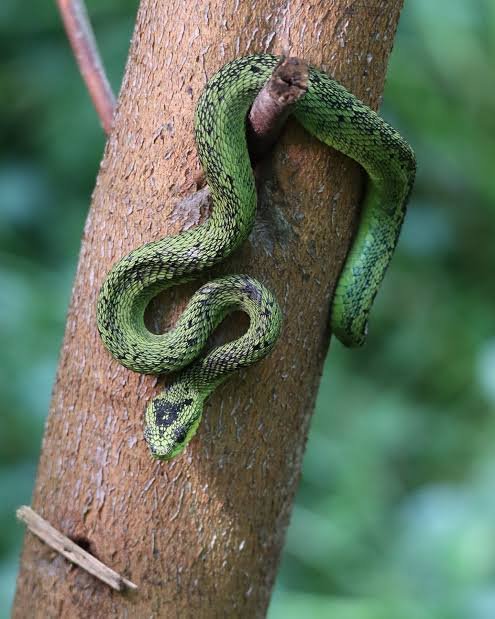
Striking Appearance
Vivid green and black patterns provide excellent camouflage in dense vegetation. They feature overlapping, strongly keeled dorsal scales that give them a bristly texture.
Triangular Head & Tail
Like all vipers, it has a broad, triangular head distinct from its neck, and a prehensile tail used to anchor itself securely to branches in the canopy.
Ambush Predators
They hunt by anchoring themselves to low shrubs or vine tangles, sitting perfectly still until prey passes within striking distance.
Nocturnal Activity
Primarily nocturnal and crepuscular, meaning they hunt mostly at night or during twilight, using hemotoxic venom to subdue their prey.